
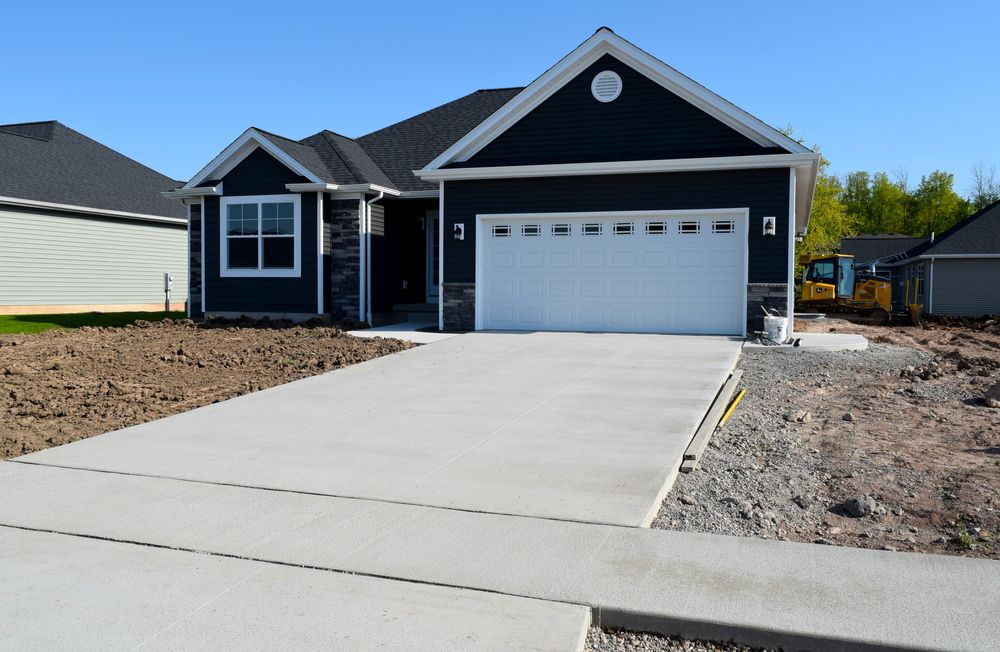
Concrete Surfaces That Handle Daily Wear
Concrete patios and driveways in Ardmore for properties with cracked surfaces, poor drainage, or vehicle access areas that have deteriorated past practical use
Residential concrete in Ardmore takes continuous use—vehicle weight on driveways, outdoor furniture on patios, foot traffic, and the slow pressure of tree roots and soil movement beneath the slab. McCarley Services pours and finishes concrete patios and driveways for homeowners whose existing surfaces have cracked, settled, or eroded to the point where they detract from both usability and the appearance of the property. The work begins with an honest assessment of what the existing surface shows, because the condition of the concrete above grade reflects what is happening at the base level beneath it.
Concrete work starts well below the finished surface. Excavation depth, sub-base compaction, and drainage slope are determined before the forms are set, and those decisions control how the finished slab behaves over time. A driveway apron that pitches correctly moves water away from the garage and foundation; one that is graded even slightly toward the structure channels runoff into areas where it causes long-term damage. Control joints placed at appropriate intervals give the slab a defined location to manage thermal movement, which is what limits random cracking across the surface face.
Request an estimate from McCarley Services to evaluate your current surface condition and discuss dimensions, drainage, and finish options for your driveway or patio project.
What Proper Concrete Installation Requires
The mix design, pour thickness, and curing process each affect how the finished concrete performs under the specific load it will carry. A residential driveway designed for standard passenger vehicles requires a minimum slab thickness and a concrete mix with adequate compressive strength; a surface that will support heavier equipment or loaded trucks needs both greater depth and a reinforced mix. Finish texture on a driveway is also a functional decision—a broom finish adds traction that a smooth trowel finish does not provide, which matters on an approach with any slope.
After the pour and curing period, what you notice is a surface that is level across its span, drains at the intended angle, and holds consistent texture without low spots or rough patches where the finish was rushed. A properly cured driveway does not dust or scale at the surface; a patio poured to the correct depth and compaction does not develop soft spots when outdoor furniture is moved across it repeatedly. McCarley Services treats the curing phase as part of the installation, not as an afterthought, because concrete that is loaded before it reaches design strength performs below its rated capacity regardless of how the pour looked at the finish stage.
Finish options for concrete patios include broom, exposed aggregate, and stamped textures, each of which involves different forming and timing requirements during the pour. Stamped concrete, in particular, must be worked within a narrow window after the pour, and the pattern quality depends on consistent slab thickness and a level form—which is why surface preparation decisions made before the pour directly affect what finish options are practical for a given project.
Questions Before Starting Your Project
The following questions address how concrete driveway and patio projects are planned and what determines the quality of the finished work.
How does sub-base preparation affect the long-term performance of a concrete slab?
The sub-base provides the stable, compacted platform the slab rests on. Concrete is strong in compression but weak in tension, meaning it depends on uniform support from below to resist cracking under load. A poorly compacted or uneven sub-base creates voids that allow the slab to flex, and flexing concrete cracks.
Why are control joints placed in concrete driveways and what happens if they are omitted?
Control joints are intentional weaknesses tooled or cut into the slab surface at planned intervals so that when the concrete moves, it moves at those locations rather than randomly across the face of the slab. Driveways without properly spaced control joints typically develop irregular cracking within the first few years of use.
What drainage slope is required for a concrete patio or driveway to function correctly?
A minimum slope of one-quarter inch per foot directed away from structures is standard for residential concrete flatwork. Surfaces that pitch toward a garage, foundation wall, or enclosed patio create persistent water intrusion problems that the concrete itself cannot correct once poured.
How long should you wait before driving on a new concrete driveway in Ardmore?
Standard residential concrete reaches sufficient strength for light passenger vehicle traffic after approximately seven days of curing under normal conditions, though the full design strength develops over a longer period. Parking heavy equipment or loaded vehicles on fresh concrete before it reaches adequate strength causes surface depression and internal cracking that cannot be corrected without removal and replacement.
What indicates a quality concrete finish versus one that was rushed during the pour?
A quality finish is uniform in texture across the entire slab, with consistent joint depth and clean edges at the forms. Surface scaling, rough patches, or color variation in the cured slab typically indicates that water was added to the mix during placement to make it more workable—a shortcut that reduces compressive strength and surface durability.
McCarley Services plans and pours concrete patios and driveways for residential properties in Ardmore with attention to base preparation, drainage, and finish quality from the first excavation to the final cure. Call (256) 431-8917 to arrange an on-site visit and get an estimate based on the actual dimensions and conditions of your property.